
Is a Firewall Enough to Secure Your School Today?
Is a firewall enough to secure your school today?
Quick Takeaway
A strong firewall matters but it isn’t a complete security strategy. For private schools, the most common risks now come from phishing, stolen passwords, and compromised logins. A layered approach one that includes MFA, email protection, endpoint security, staff awareness, and reliable backups creates real resilience while avoiding the performance issues that come from overloading an aging firewall.
Recently, we visited a private school to review their network performance. Teachers were experiencing slow internet, cloud applications lagged, and day‑to‑day digital learning tools weren’t performing the way they should.
When we reviewed the environment, one thing stood out immediately: their firewall was extremely outdated and overloaded with security services.
We suggested that by modernizing the firewall and rethinking how security services were deployed, the school could significantly improve bandwidth and performance without reducing security. The response we received was understandable, but concerning:
“School cyberattacks are up 50%. We don’t want to mess with the firewall.”
That statement highlights a common misconception in school IT security: the belief that the firewall is the single most important and sufficient line of defense.
It isn’t.
The Firewall Fallacy: One Wall Doesn’t Secure a Campus

Is a firewall enough to secure your school today?
Firewalls absolutely matter. They are a critical component of any security strategy. But relying on a firewall alone is like locking the front door while leaving windows open, staff untrained, and no cameras inside the building.
Modern cyberattacks against schools rarely rely on brute‑force network attacks. Instead, they tend to exploit people and identity. Common entry points include:
· Phishing emails sent to teachers and staff
· Stolen or reused passwords
· Malware introduced through legitimate logins
· Ransomware executed after a single click
Once an attacker is inside, the firewall is no longer the control point.
Multi‑Factor Authentication: The Moment That Changes Everything
There’s a simple question every private school should ask:
What happens if a teacher’s password is stolen?
Not hacked. Not brute‑forced. Simply reused from another website or captured through a convincing email.
If an attacker logs in with valid credentials, they don’t trigger alarms. They don’t break in. They walk in through the front door.
This is where multi‑factor authentication (MFA) quietly becomes one of the most important security decisions a school can make.
MFA isn’t about technology it’s about slowing attackers down at the exact moment they rely on speed.
It introduces a pause. A second check. A moment where the system asks, ‘Is this really you?’
And that moment often makes the difference between a harmless login attempt and a full‑scale incident involving email access, student data, or financial systems.
Firewalls protect networks. MFA protects people.
In an environment where staff move between classrooms, homes, coffee shops, and personal devices, identity has effectively become the new perimeter—whether schools intend it to be or not.
What a Layered Security Model Looks Like for Private Schools
A strong security posture distributes protection across multiple layers so that no single failure turns into a crisis.
Email Security: The Front‑Door Attack Vector
Most school breaches start with email. The real question isn’t whether filtering exists it’s whether anyone is actively paying attention as threats evolve.
Consider whether:
· Phishing emails are stopped before they reach inboxes
· Suspicious links or attachments are analyzed before being opened
· Email security is reviewed and adjusted as attack methods change
Endpoint Detection & Response: Assume Breach, Detect Fast
If a teacher clicks a malicious link, what happens next? Endpoint protection exists to detect and contain suspicious behavior after a user signs into something a firewall can’t see.
Security Awareness Training: Teachers Are Part of the Defense
Teachers don’t need to become cybersecurity experts, but they are part of the security system. Short, relevant, and consistent training helps staff pause before clicking and report issues early.

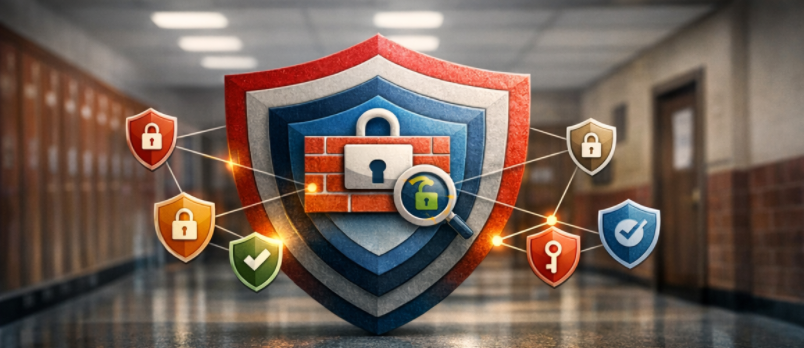
Strong security isn’t built on a single device — it’s designed layer by layer.
Password Management: A Small Habit With Big Impact
Passwords remain one of the most common paths attackers use. Reducing reuse and encouraging better habits quietly lowers risk without disrupting daily work.
Backups: When Prevention Isn’t Enough
Eventually, something will go wrong. When backups are protected, tested, and reliable, even serious incidents become manageable rather than catastrophic.
Where the Firewall Fits (And Where It Doesn’t)
The firewall should control traffic, segment systems, and provide visibility. A firewall should not carry the entire security burden. Trying to stack every security function onto a single aging device often leads to performance issues and blind spots.
A Final Thought for Private School Leaders
If your school’s security strategy starts and ends with a firewall, it may feel safe, but it isn’t.
The better question isn’t: “Is our firewall strong enough?”
It’s: “If something gets past it and eventually something will, what happens next?”
That’s where real security lives.