
Email Encryption for Omaha Businesses You Already Have!
Email is still the backbone of business communication. It’s how payroll gets sent, how tax documents move, how patient forms are shared, and how invoices are approved. It’s also one of the most common ways sensitive information quietly leaves an organization.
What makes this more frustrating is that many businesses already have a built‑in way to reduce that risk—and almost never use it:
email encryption.
Not an expensive add‑on. Not a new security product. Just a feature that already exists in many modern email systems.
So here’s the uncomfortable question we encourage clients to sit with for a moment:
If you felt the email needed to be sent securely… why wasn’t it?
For Omaha CPA firms, accounting and bookkeeping offices, medical practices, dental offices, and therapy clinics, this question comes up more often than people realize.
Why Email Encryption Rarely Gets Used
When we work with small and mid‑sized businesses, the issue is almost never that people don’t care about security. In fact, it’s usually the opposite. People do care—but the behavior doesn’t always match the intent.
That gap tends to come from a few very human reasons.
First, many users simply were never shown how to encrypt an email. They know how to attach a document. They know how to forward a message. But encryption is either hidden behind a menu, tucked away under “Options,” or requires something specific like typing Encrypt in the subject line. If no one explains it during onboarding or training, most users will never go looking for it.
Second, there’s a strong fear of inconveniencing the recipient. Users worry the encrypted message will confuse clients, create extra steps, or generate a support call. In professional services, no one wants to look difficult or overly cautious—especially when deadlines are involved.
So instead, sensitive information gets sent the easy way: a spreadsheet with Social Security numbers, a PDF with tax data, or a patient form with insurance details—all delivered in plain text email.
The irony is that modern email encryption, especially in Microsoft 365 environments, is far less disruptive than most people expect. Many recipients can open the message with a simple one‑time passcode or directly in their inbox if they’re also using Microsoft. It’s slightly less convenient than clicking an attachment—but when sensitive data is involved, that tradeoff is more than reasonable.
Finally, there’s the quiet judgment call that happens in the moment: “This is probably fine.” But if you slow down and ask a better question—Would I be okay if this email was forwarded, misdelivered, or compromised?—the answer often changes.
That hesitation is important. It’s a signal.
Intent vs. Action Is Where Risk Lives
Most data exposure doesn’t happen because someone is careless. It happens because someone knew the information was sensitive, intended to be responsible, and still didn’t use the secure option available to them.
From a business and compliance standpoint, intent doesn’t carry much weight. Outcomes do.
That disconnect—between knowing better and doing better—is exactly where unnecessary risk lives.
“Don’t We Already Pay for This?”
One of the biggest misconceptions we hear is that secure email requires buying yet another security product.
In reality, many organizations already have access to some form of encrypted or protected email through their existing email platform, including common Microsoft 365 plans. The challenge usually isn’t cost. It’s awareness, configuration, and habit.
Even in situations where one‑click message encryption isn’t available, there’s still a simple step most businesses can take immediately.
The Bare Minimum Everyone Should Be Doing
If your organization isn’t ready to standardize encrypted email across the board, set at least one clear expectation:
If the email itself isn’t encrypted, the document should be.
Password‑protecting a file isn’t perfect—but it’s dramatically better than sending sensitive data completely unprotected.
When done correctly, the password can be shared separately, forwarded emails don’t automatically expose the contents, and a compromised mailbox alone is no longer enough to access the data. Just as importantly, it forces people to pause and acknowledge that what they’re sending actually matters.
That pause is the beginning of better security habits.
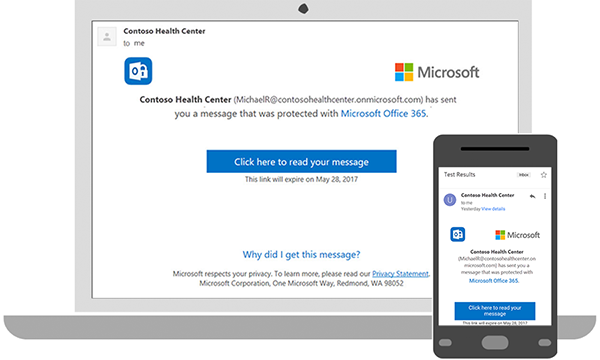
M365 Email Encryption Notification
Encryption Sends a Message
Using encryption isn’t just about protecting data. It communicates intent.
It tells employees that certain information deserves extra care. It tells clients that their data is taken seriously. And it shows regulators and auditors that reasonable safeguards are in place.
Not using it sends a message too—it just isn’t one most businesses would choose if they stopped to think about it.
What This Looks Like in Finance and Healthcare
For Omaha‑area CPA firms and healthcare providers, the line is usually clear. Tax returns, payroll data, banking details, patient forms, insurance information, and anything containing Social Security numbers or account details should never be treated as casual attachments.
The goal isn’t to slow work down. It’s to make secure communication feel normal—just part of how professional services operate.
That only happens when expectations are clear, the process is simple, and people are shown what “good” looks like.
Final Thought
If you ever catch yourself thinking:
“This email probably should be secure…”
You already have your answer.
Email encryption isn’t underused because it doesn’t work. It’s underused because it hasn’t been made normal.
And normalizing it—whether through encrypted messages or password‑protected documents—is one of the simplest, most effective security improvements most organizations can make.
If you’re an Omaha business, especially in accounting, finance, or healthcare, we help make secure email a standard process—not a special occasion.
We’ll review what your current email system already supports, configure the least disruptive secure‑send options, and give your team clear guidance on when and how to use them. In most cases, this takes less than an hour and immediately reduces risk.
If you’d like a Secure Email Checkup, reach out to us. We’ll confirm what you already have, what’s missing, and how to standardize secure communication without slowing your business down.
Infinite Technologies USA — helping Omaha SMBs feel like they have an internal IT and security team.