
Why Every IT Company Says They Offer Managed Services
TL;DR
Many IT companies now say they offer managed services, but most are only managing their product, not your entire IT environment.
That distinction matters.
When services are product‑focused, gaps show up as:
Vendor finger‑pointing
“Out‑of‑scope” work
Billable tickets
And businesses stuck coordinating problems
True managed service providers exist to own the outcome, coordinate all vendors, and manage IT in a way that supports the business — not just the tools.
If no one clearly owns the problem when something breaks, you may not be buying full managed IT — even if it’s marketed that way.
Why Every IT Company Says They Offer Managed Services — And Why That’s Confusing for Businesses
If you’re a small or mid-sized business in Omaha (or anywhere else, really), it probably feels like every IT-related company now claims they offer ‘managed services.’
ISPs offer managed networking. Security vendors offer managed protection. Copier companies offer managed IT. Cloud providers offer managed infrastructure.
On paper, it sounds great. Everything is ‘managed.’ In reality, the term managed services has become so diluted that businesses are often left wondering why they’re still dealing with outages, finger-pointing, and surprise IT bills — despite paying multiple providers every month.
The issue isn’t IT complexity. It’s confusion over what’s actually being managed — and what isn’t.
How ‘Managed Services’ Lost Its Meaning
Most companies that sell IT-related products expanded into managed services for a simple reason: recurring revenue.
That shift led to hardware vendors managing their devices, software companies managing their platforms, and ISPs managing connectivity. None of that is inherently bad. The problem is that product management started getting marketed as full IT management.
Those two things aren’t the same—and that’s where the confusion (and frustration) usually starts.
Managed Products vs. Managed Environments
Here’s a simple way to tell what kind of “managed” you’re being offered.
When a company says they offer managed services, what they usually mean is that they manage their product, not your entire IT environment.
1) Managed product (common with ISPs, software vendors, hardware vendors, and OEMs)
In this model, the provider takes care of their system—and they may do that very well.
What that usually looks like in practice:
Monitor and maintain a single system or platform
Track uptime and performance only for their product
Provide support limited to clearly defined boundaries
Stop responsibility when an issue touches something else
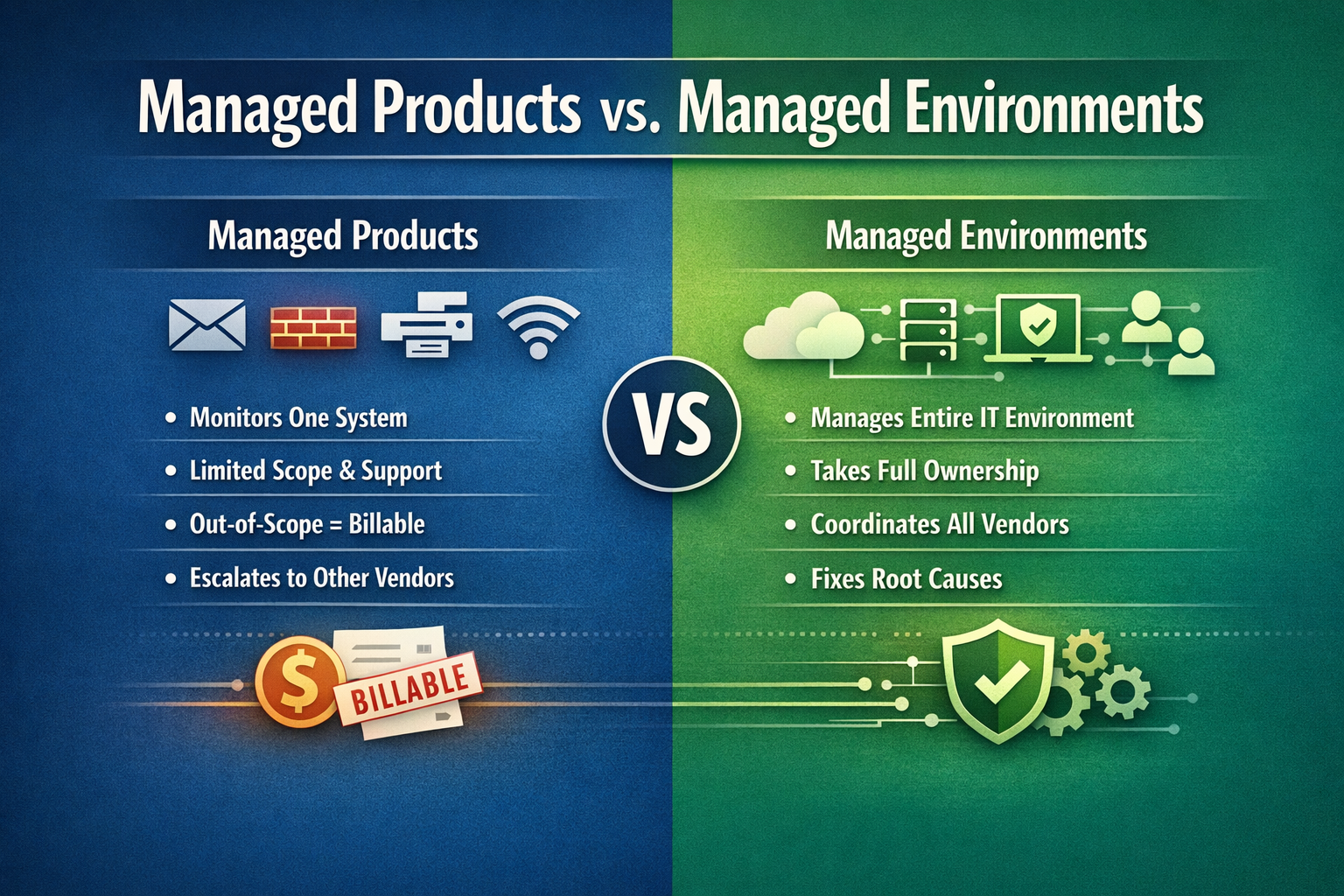
And when an issue crosses outside that boundary (which is common), you’ll often hear some version of:
“That’s not our system”
“You’ll need to contact the other vendor”
“We can help, but that falls outside scope”
In other words, the problem doesn’t go away—it just shifts into “out of scope,” which usually means additional time and cost.
2) Managed environment (what true Managed Service Providers are built to do)
(What true Managed Service Providers are built to do)
Instead of managing a single tool, an MSP is responsible for how your whole environment runs day to day, including how systems work together and what happens when they don’t.
The entire IT ecosystem, not individual tools
How systems interact, fail together, and recover
Business workflows, users, security, and risk
Owning the outcome, not just the alert
When something breaks, the question isn’t whose product it is — it’s:
“What’s the impact, and how do we fix it?”
That difference is why two companies can both claim to offer managed services — and deliver completely different experiences.
Why This Matters (Especially for SMBs)
The reason this distinction matters is simple: most real IT problems don’t respect vendor boundaries.
For example: an “email problem” rarely lives in one place. It can involve your user accounts and sign-ins, security policies, the mail platform itself, the device someone is using, and even your internet connection.
When each provider is only responsible for their piece, gaps appear—and those gaps tend to show up as:
Add-ons
Emergency fees
Professional services
Or long-running, expensive support tickets
Managed environment services are designed to reduce that fragmentation by giving you one team responsible for the full picture—so issues get owned, coordinated, and resolved without you having to play traffic cop.
What They Don’t Offer — And Why That Costs You More Than You Think
This is the part that often gets skipped (not always intentionally): different providers define “managed” very differently.
Many non-MSP “managed” offerings don’t include things like end-to-end troubleshooting across systems, coordinating multiple vendors on your behalf, understanding how your team actually works day to day, proactive planning, or clear accountability for outcomes.
So when a problem spans systems — and most real problems do — the clock starts ticking. That’s when businesses see hourly charges for ‘out-of-scope’ work, emergency support fees, professional services add-ons, and multiple vendors billing for the same incident.
A monthly fee can still be a good value—but it’s worth understanding what’s included before you assume it covers the messy, multi-system problems that take the most time (and cost the most in downtime).
A helpful way to think about it is: what will it cost (in time, money, and stress) when the issue doesn’t fit neatly into one vendor’s box?
Why Managed Service Providers (MSPs) Exist in the First Place
Managed Service Providers didn’t emerge to sell tools. They emerged to own responsibility.
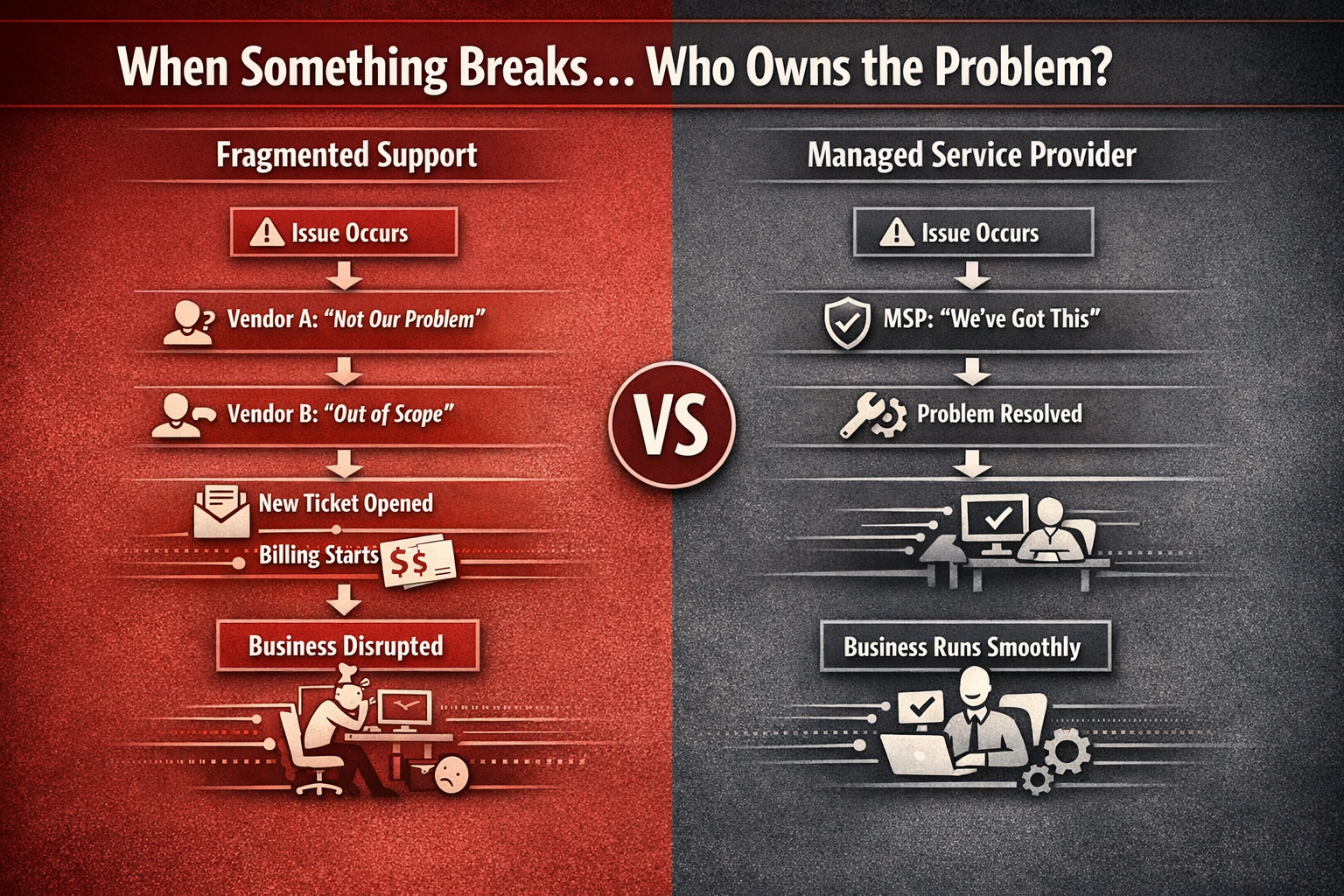
A true MSP — whether in Omaha or anywhere else — is designed around managing the entire IT environment, acting as a single point of accountability, preventing problems (not just reacting to them), and aligning technology decisions with business needs.
That means the MSP coordinates vendors instead of deflecting, fixes root causes instead of resetting symptoms, plans for growth, risk, and continuity, and understands how downtime actually impacts people.
This isn’t about having better tools. It’s about having ownership.
The Difference Shows Up When Things Go Wrong
When multiple ‘managed’ providers are involved, problems often sound like: ‘That’s not our system.’ ‘It’s working as designed.’ ‘You’ll need to contact the other vendor.’ ‘We can help, but that’ll be billable.’
When an MSP is involved, the response is different: ‘We’ll take this and figure it out.’ ‘Here’s the impact and the fix.’ ‘Here’s how we prevent this next time.’
That’s not magic. That’s accountability built into the service model.
Why SMBs Feel the Pain First
Small and mid-sized businesses are hit hardest by this confusion. You don’t have an internal IT department to coordinate vendors, time to play referee between providers, or margin for extended downtime.
So when everyone manages their piece but no one manages the whole picture, the business absorbs the cost — in lost productivity, stress, and risk.
Managed Services Isn’t About Tools — It’s About Outcomes
The most important distinction businesses can make is this: Managed services is not about what someone monitors. It’s about who owns the outcome.
If a provider manages a product, they protect the product. If they manage a platform, they protect the platform. If an MSP manages your environment, they protect the business.
Those are fundamentally different promises.
What to Ask When a Company Says They Offer Managed Services
When a provider says they offer managed services, the term alone doesn’t tell you much.
The real difference shows up in how they think about responsibility.
A few questions can quickly reveal whether a company is managing your business — or just their product.
What are you fully responsible for, and what isn’t included?
Gaps here often turn into billable tickets later.If a problem spans multiple systems, who owns it?
Most real issues do. If the answer involves calling another vendor, responsibility is fragmented.Are fixes included, or just monitoring and alerts?
Alerts don’t solve problems — people do.How do you decide what’s right for our company?
Tool-first answers usually signal product-driven services, not business-driven ones.What does not trigger a billable ticket?
This question alone often tells you what “managed” really means.
If a provider’s approach isn’t centered on doing what’s right for your business as a whole, then managed services may simply be a packaging label — not a partnership.
If you’d like, we’ve also put together a practical checklist you can use during any MSP or vendor conversation.
Final Perspective (For the Industry)
The IT industry doesn’t lack tools. It lacks clarity.
Calling everything ‘managed services’ may help sales decks, but it leaves businesses paying more — and understanding less.
MSPs are not better because they do more. They’re better because they take responsibility for the whole.
And in a world where IT touches every part of a business, that distinction matters more than ever.